Sunday, December 2, 2012

Old World Blues

You know, it's interesting how and why someone who has taken a break from blogging decides to come back. For me, traditionally, it requires a certain level of intellectual (or, more frequently, emotional) reserves, and often, some external impetus, something I feel a need to share, and tonight, at 2.36a, here I am at the keyboard, about to do just that.

Please understand this won't be particularly pithy (I expect), not terribly insightful (I imagine), and possibly less coherent as time ticks by and my body wonders why I don't love it anymore. This is going to be...well, a little bit of a game review, but any of you reading this likely know how my brain works, so you know that it likely will wander from the topic soon enough.

I just finished the third DLC (downloadable content, referring to the distribution method for an expansion) for Fallout: New Vegas, called Old World Blues. OWB has been around for a couple years now, but this is my first go at it. I want to talk about it because it is an excellent example of storytelling and game-crafting done terribly, beautifully right.

Your hosts when beginning Old World Blues.

In classic form, when you leave the Mojave to start the DLC, you awaken with no idea of your geographical location, and no idea where...well, certain things have gone off to. It takes little time to meet your hosts, and you are turned loose in a new sandbox absolutely filled with cool locations and a lot of humor. OWB is an homage to pulp-scifi movies of the '50s and '60s, and it takes a lot of those wonderful tropes and runs with them. 

Okay, so this isn;t really going to be a review. Lots of those out there already. Onward, then.

OWB is, hands down, the best expansion for a game I have ever seen. If it was a game on its own, it would be fun, but (of course) far too short. As it is, I still spent something like 20 hours in the Big MT, and didn't do probably half of what there was to do. It is a sandbox, completely open for you to explore in any order and direction you wish, it has an explanation why you cannot leave (greater than "It's a really fucking long way home and you're too lazy to go back right now," like so many), and it has many layers of clearly-defined goals that you can pursue as you wish. 

The personalities are fantastic and painted in caricature, and that is necessary in the interactive environment of a game, else the hordes of people you meet just blend into the same boring shades of grey. Not fifty of them, don't get excited, sheesh. The things you can do are varied and interesting, the humor is campy, but there is also this very serious undercurrent, a message the Big MT (say it aloud and you'll sound just like you're from New Vegas!) is trying to teach your character, but also trying to teach you. It ties into a much larger story that encompasses the entirety of New Vegas, its DLCs and, truth be had, the Fallout universe itself.

While the Mojave can often seem rather impersonal, the Big MT (and truthfully, Dead Money and Lonesome Road, too, and not coincidentally those are the DLCs most closely associated with OWB) is deeply, almost disturbingly personal. I developed attachments to the personalities and locations of the Big MT far more than I expected, especially as none of them travel with you or do the companion thing, exactly. There was a sense that I--my courier, my wasteland wanderer--was important, and that is a feeling that is often missing in any game without feeling heavy-handed ("We are telling you that you are important! Prophecies have been spoken! You are destined!" Blah blah fucking blah boring). You tease this knowledge out of the DLC, you piece it together bit by bit, slowly growing a larger view of what is going on in the world and how...if not yet why...you are so critical. It is subtle, and it is a thing of wonder.

Ultimately, the thing that tells me OWB is fantastic is how I felt when I finally had the chance to return to the Mojave...and when I got there, I was sad. Sure, I can go back to the Big MT whenever I want, and many of the friends I made there will be waiting for me (and all of the enemies I left in peace, too), but the Mojave seems so...foreign to me now, and I already find myself longing for the bizarre retro pop-sci unreality of the Big MT. OWB will always be a chapter I play whenever I play Fallout: New Vegas,  because in all the Mojave, I finally found a place where I could say, "My god, I'm home."

5/5, if you're wondering.

Tuesday, July 31, 2012

Life Gets in the Way

I know blogs traditionally get a bit mired in the summertime, anyway, but for regulars and visitors I feel the need to clarify--this blog is not dead, it's just that life is getting in the way at the moment. More looks at gaming, ATOMIC and random artwork will start popping up again as the dust settles.

Monday, July 9, 2012

Sketchbook

In an effort to redesign the realms of fantasy, here's a cyclops making a threatening roar.


Monday, June 25, 2012

I Create, Therefore, I Am

Creation has a particular energy. It can be catalyzed by outside influence, it can be channeled any which way, but there is no denying that the energy comes from within the creator. Inspiration of any stripe, whether the head-spinning altitudes of love or the blood-soaked sorrows of despair, serve merely as the trigger ready to unleash the whole thing upon the canvas of the creator's choosing--paint, dance, pencil, garden, auto, sex, game, poem, song, research, what have you.

My current canvases are pencil and paper, the word processor, and the game. Drawing and writing are sort of self-evident, and the day will soon come when I can explore other canvases, but tabletop gaming is something that may need elaboration.

Role-playing at the table with a group of friends is a collaborative work of art. It is a sort of cooperative storytelling, which has been a fixture of human history that has largely been lost in America. We joke and talk about the rest of our lives as we sit at the table, but we also tell a story, of characters we grow to know and love and hate, facing a world that is even more uncertain than our own while allowing more decisive actions than we can usually take in the world of electronics and red tape. We grow legends in these game sessions, vicariously living in a world that, for many, can become as familiar or even moreso than our own.

They are legends because they do not simply cease to exist when we leave the table. Their stories live on, in our imaginations during quiet moments, during conversations of remembrance, and when telling others of the daunting tasks faced and overcome by (or occasionally, which overcame) our heroes. Each player becomes tied to the others through this ancient rite, and it grows our hobby and grows us as creators of this amazing experience.

Friday, June 22, 2012

Boldly Going, Part 2

An explorer and his pet human.
Okay, before the the second Great Flood descended upon Duluth, I was discussing exploration for my ATOMIC tabletop role-playing system. I talked about landmarks and Schrödinger's manhole.

One thing I hadn't gotten to was that random locations can be used within the controlled environment of a dungeon (a self-contained, generally interior location for adventuring that is somehow isolated and distinctly different from the external environment and populated by hostile "others," and which, in ATOMIC's case, includes derelict auto factories, abandoned sewer systems, the husks of skyscrapers, etc.) in the same way. Perhaps the location itself (a particular room) is known, like the radioactive swamp in the previous post, but its contents are undefined, and the random location can fill it in. In other cases, perhaps there is a hidden panic room behind the pile of collapsed rubble. You get the idea.

However, I promised to talk about the way a system's rewards drive play, and how exploration can benefit from that. Don't worry, I haven't forgotten. We'll get there.

It has been noted by minds greater than mine that outdoor travel in tabletop games can be problematic. Part of the problem is that we are used to hand-waving travel at the table unless a random encounter is rolled (this is reinforced by fast-travel options in video games like Fallout: New Vegas and World of Warcraft). Another part is that the outdoors is so huge, we can envision it easily (we see it every day) but how do we begin to describe it? Just like any other aspect of an RPG, the central focus needs to be what -C at Hack & Slash terms "player agency," the ability of players to make meaningful choices in the game. This means the GM needs to tell players environmental information that they can actively apply to the decision-making process. Ideally, no more, no less. In a dungeon environment, this is simple, as movement is restricted by things like walls and line of sight. Outside, however, they could literally wander off in any direction.

This requires a subtle bit of gaming when using a system that does not require maps. The GM should describe visible landmarks to give the players a star to guide by, and randomly-rolled locations become visible from a distance that makes sense. This, of course, is made easier if the characters use their travel time to discuss strategies, or backstories, or other party interactions, so finding locations becomes more organic, and it feels like the characters have actually been traveling instead of their travel being "interrupted" by encounters or discoveries. If players decide to explore, they can tell the GM how much time they want to spend doing so. Random encounters are rolled every hour while exploring, so the players can have a concrete idea of the risk up front.

To reward this behavior, ATOMIC GMs have two simple, powerful motivators. Skill points (SP), which are spent to upgrade skills, and experience points (XP), which are used to purchase perks, which improve character abilities, and whammies, which are fun and interesting new abilities that the bad guys probably won't like. Discovering a new location by physically arriving there (not just seeing it off in the distance), awards 1 SP and 50 XP. To give an idea what impact this has, it takes 25 SP to improve a skill and 500 XP for a perk and 1000 XP for a whammy. Now if a given area of about 25 square miles has three landmark locations, and half a dozen Schrödinger's manholes pop up, a party spending a day exploring that whole area (taking the time to risk random encounters that may shoot them or eat them or set them on fire or some combination) will gain 9 SP and 450 XP--almost enough for a perk by itself, without any XP from quests.

Combat in ATOMIC is intentionally lethal and monster kills do not earn XP, so it is a balancing act, an active and interesting choice for a group to decide whether to risk it and explore or stay safe and advance in character ability more slowly.

Questions, comments, snide remarks?

Thursday, June 21, 2012

Story Hook Thursday


My buddies, they told me about this.  They called it spacer sickness, but this wasn’t what I expected.  I feel like the emptiness between the stars outside the frosted glass of my cockpit is somehow aware, perhaps even intrigued.  I dunno why it feels that way, but I swear on a stack of Bibles it does.
And I swear It’s calling me.

Andy clicked off the toggle switch on his recorder.  He shook his head, a little embarrassed, and closed the device carefully, so he wouldn’t blow any of the precious remaining vacuum tubes.  It was damned easy in this cold.
He slid the war-green metal recorder into the stiff leather satchel and reached up to rub away the ever-encroaching frost.  Through the thick glass lay nothing at all but the distant pinpoints of stars.  The way his plane was lazily tumbling, it would be another hour before the somewhat brighter, somewhat closer star he hoped was the sun would warm the cockpit enough that he could take off his gloves for a few minutes without worrying about frostbite.  Time enough to pee, maybe eat some K-rations.
Andy didn’t dare open the door leading to the cargo hold.  The seals had held so far, and the filters were still keeping his air from going stale.  He had power in the cockpit, but a short would deprive him of the tiny bit of residual heat from the electrics and more importantly, wipe out his radio set, so he kept almost everything switched off unless he needed it.
A stutter in the crackle from his radio headset caught his attention, like it always did, but as he hiked up the gain on his radio receiver, the stutter was gone, leaving only the endless sibilant background hiss of a jillion stars.
Not for the first time, he glanced around the cockpit, looking for something…no, really anything with which he could improve his situation.  The floating tumble of piss-bricks held by netting on the other side of the copilot’s seat, the succession of K-ration cans ready to thaw inside his clothing after he ate next, a couple girlie and Popular Mechanics magazines, manuals about the starplane and pilot procedure.  The copilot’s seat was stripped to its wire frame, the padding and leather cover now part of Andy’s nest.  The remains of several large chemical warming pads were also tucked around him; after every calorie of heat had been wrung from them they made good insulators between his body and the frame.  He was wearing Edgar’s flight coat, and he hoped again that Edgar didn’t need it.
He must have dozed, because he suddenly noticed the frost on the inside of the cockpit glass was brighter.  He rubbed away the space he tried to keep clear of ice and squinted past the surrounding glare.
The bright star wasn’t there.  He couldn’t spot the brighter stars, nor the Galactic Band.  Then, a glint of twice-reflected light illuminated a slim edge and the tiny crescents of a handful of distant rivets.
He cranked up the radio, switching on main power as it groaned to life.  The hiss in his ears got louder, and as he fiddled with the tuner, he yelled into the microphone.
“Mayday!  Mayday!  Unidentified plane, this is Andrew Williams aboard the Lady’s Grace, do you read?  Mayday!  Mayday!  I have been adrift for several days, repeat, the Lady’s Grace is disabled!  This is Andy Williams!”
He frantically shouted into the microphone, sliding through frequencies as quickly as he dared, straining to hear any sign of a response.  His mittened hands were clumsy on the dial, and he felt panic well up in his throat as the light over his canopy faded.
“Mayday!  Mayday!  Can anyone hear me?”
There was an impact, a sickening lurch, and Andy felt the plane move.
“Mayday!  Mayday!  This is not a derelict plane!  Repeat, there is at least one survivor on the Lady’s Grace, do you copy?  The cockpit is pressurized and there is a survivor on board, I repeat, a survivor on board!”
As the starplane swung lazily, Andy swore.  He held the microphone as well as he could as he struggled out of his warm nest and desperately scrabbled at the impossibly stiff voidsuit.  If anyone breached the cockpit, that’d be it, no air, no warmth, no nothing.  He had seen a man in void without a suit, and the man had lived fifteen whole seconds as he simultaneously suffocated and froze to death.
Not the way Andy wanted to go, that was for damn sure.
The rings around the right shoulder creaked ominously as he tried to shove his arm through the sleeve.  The suit had been flattened and frozen for over a week, and it was not giving up its reposed posture without a fight, but Andy maybe only had moments before a scavenging crew would pop the seals and blow the whole cockpit into void.  He flailed his arms about, trying to find the button on his microphone so he could keep sending strangled yells over the radio waves.
He heard the heavy steps of magnetized boots through the steel of the frame.  Zipping the frosted zipper in a puff of icy motes he sent himself bouncing against the ceiling, grabbing at the helmet.  The suit was not rated for any real length of time in void, but it gave a man more than fifteen seconds.  The helmet went on backwards, but Andy could feel footsteps closing, so he locked the seals down.  He cranked open valves in a panic, feeling the icy hiss of canned air fill his suit as he turned the suit’s radio crank hard to juice it up.  He clicked a dial on his helmet after remembering it was on the other side.
“Mayday!  Mayday!  There is a survivor aboard the Lady’s Grace!  My name is Andrew Williams!  Please don’t…”
Air buffeted him, knocking him toward the door of the cargo bay as it fled into void.  Andy tried to turn around to see who had opened it, but of course he couldn’t.  Dammit.
A thick hand felt thicker on his shoulder through the frozen layers of canvas, leather and rubber.  He was turned, gently, hands patting him down.  He grabbed for an arm, and the radio speaker in his helmet sizzled to life.
“Hello, Mr. Williams.  Please do not fight me.  Your helmet seems to be on backwards.”
Something about the voice made Andy stop.  There was something odd about the words, even and almost metered.  He let himself be pulled backwards, toward the cargo bay.  Another pair of hands helped steady him, and he felt the metallic clink of a safety tether being attached to his belt.  He drifted along, tugged slightly this way and that, feeling the cold of outer space like claws finding every thin spot in the suit, sucking away what little body heat he had left. He reached up to crank the air valve all the way open to offset the alarming leakage he could feel somewhere near one ankle, found another hand already there adjusting it for him. 
Before too many minutes the inside of his helmet brightened and he felt his hand being guided to a hand hold of some sort.  He gripped it and it pulled him upward.  When it stopped, he was aware of the suit’s increasing suppleness. Wherever he was, it was warmer than anywhere he’d been in weeks. 
He tried to crane his neck around, but all he saw was a sliver of glare coming through the tiny viewport in the front of the helmet.
And then hands were on his shoulders, on his neck!  He panicked, swinging wildly at his invisible assailants, hyperventilating from terror and in an effort to flood his body with extra oxygen.  Hands, then more hands, pinned his arms to a wall, then more hands pinned his legs, and he couldn’t do anything but keep hyperventilating until his vision swam.
The helmet turned, and Andy blew out his breath, screwing his eyes almost entirely shut as it was lifted up and off.
His face did not freeze, nor were the last tattered bits of his breath being wrenched from his body.  He slowly relaxed his eyes, and when his lungs could no longer take it, he sucked in a huge breath.
Of clean, warm air.
He gulped another lungful, then another, gasping as several men in voidsuits released his arms and legs to hang weightless in the whitewashed chamber.  Andy could do nothing but gulp down air as his eyes adjusted to the brightness.  Before long, a canvas pouch with a drinking tube was held up to him.  He took a sip, sputtering when hot coffee coated the inside of his mouth and throat.
He chuckled along with his rescuers as he took another sip, this time prepared.  “Thanks,” he croaked.
“You are quite welcome,” came the reply, in that same metered voice.  He turned slowly, sucking down the coffee.
She was a beauty, this one, that was for sure.  Long black hair like the void itself which shimmered blue with reflected light, heavy lids and lips that promised and denied at the same time, generous figure made even more interesting in zero-G, clad in a creased black suit.
Accessorized by a red armband emblazoned with the broken Nazi cross.

Wednesday, June 20, 2012

Flooding in Duluth

So, this is something of an aside. Due to the recent attempt of the Apocalypse to destroy the Twin Ports, my second post regarding exploration is going to be delayed by one. I went for a drive this afternoon, once the deluge had abated, looking for some of the damage from the storm. It seems I wasn't the only one, but I was the only one I saw trawling some of the off-the-beaten-path neighborhoods.

I saw the lake the Zoo has become, so the early reports make a lot more sense to me now. Many people stopped and parked along Grand Avenue to approach the fence and look, but I simply drove past and took a lovely picture of my passenger side seat belt and the top of a bush. I suck at taking pictures blind. Or that picture, at least.

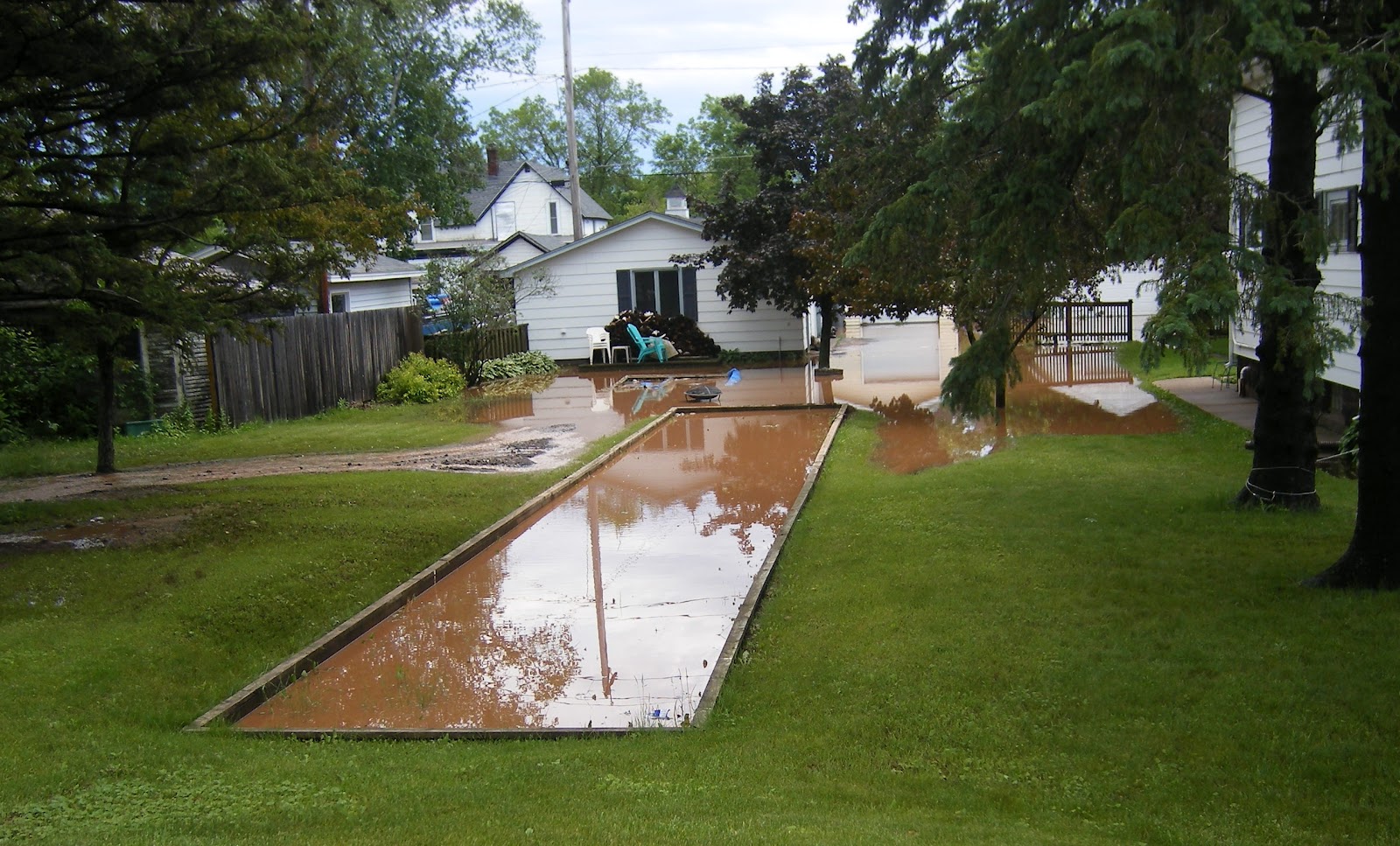
However, back off the main drags (which were uncharacteristically...gridlocked!), there was plenty of damage. I got a few pictures, but had to cut my sojourn short due to rising temperatures and enough steam to make any Finn happy.Click the pictures for full size.

Garden converted to a rice paddy. Or a crappy pool.

From the erosion of the substrate. Like winter isn't hard enough on roads.
Correct me if I'm wrong, but aren't drains supposed to go the other way?
A lot of road from uphill after relocation.
Look closely. Those washed-out sections are 3-4 feet deep.

Update: I just discovered that in our part of town, we got over 10 inches of rain. All at once. Equivalent to about 95 feet of snow. I LOVE it up here.

So, that's the news from Lake Wobegon, where all the women are strong, all the men are good-looking, and all the children are above average.

Tuesday, June 19, 2012

To Boldly Go Where (You Have Never) Gone Before

Pic unrelated.

As discussed in the last post, exploration is something that video games do fairly, even exceedingly, well, but tabletop systems have difficulty with. Let me explain what I mean.

In the freeform collective narrative of a roleplaying game, the storytellers and the audience are one and the same--the players, including the GM. As such, this small group is the only demographic the night's game session is targeting, and because our playing time is limited by life, we want to get to the "good part" quickly, and stay there as long as we can. What the "good part" of the game is depends on the group, and usually the night. Sometimes, it's spending a session playing through a day-long shopping trip in the bazaar of a fantasy city. Other times, it's brainstorming potential solutions to problems the characters face. Still other times, we just want to kill monsters and go through their pockets for loose change.

Because of this focus, travel takes (or should take, if everyone's on the same page) exactly as much time as it remains the good part (yeah, I'm tired of the quotes) or, that failing, exactly how long it takes to get from one good part to the next. Generally, traveling is only the good part if something happens en route, or, as in our recent Vertigo game sessions, if there is planning and plotting and discussion to be done. Otherwise, a trip of anywhere from five minutes to five weeks can simply be hand-waved in order to get to the next good part and move things along. We, of course, see this aplenty in TV shows and movies, Star Trek being a fine example (so I guess the pic was related, after all).

That sort of narrative pacing works just fine for most RPGs, but I want ATOMIC to have exploration as a focus. The world is a wasteland, with nearly two centuries of industrial development interrupted, then finished off, by catastrophes that almost ended everything, followed by another century of survival and the struggle to regain any scrap of the greatness was lost. The players' characters are newcomers to this, or at least people without knowledge of the world beyond the horizon and the chatter of the local radio DJ, so a big part of the adventure, as well as a big part of the reward, is broadening those horizons, seeing what has become of the world, and finding places that are exciting, dangerous, unusual, or just damned cool.

Pic related.

In order for that to be a realistic goal, the rules of ATOMIC need a structure that encourages and rewards exploration for its own sake. Complicating this challenge is the fact that I do not want to force the GM to create maps ahead of time. I would much rather have them use an old postcard or gas station road map (I got a great one of Long Island from 1957 via eBay for my Fallout: New York* tabletop game) if anything, and those are pretty sparse with detail beyond towns and roads, most of which are extinct, defunct or otherwise misrepresented on the map now, anyway.

Here is my current thought, borrowing an idea or two from video games like Fallout and World of Warcraft. First, any campaign area (like Long Island/NYC in Fallout: New York, or maybe Denver and its environs, or the DC Crater) should include a number of readily-identifiable landmarks. These are large natural features like the Rocky Mountains or Lake Huron, artificial constructions or monuments like Crazy Horse Mountain and the Hoover Dam, ruins like the Golden Gate Bridge or St. Louis, and living settlements of decent size like Megaton near DC or the Empire State (housed in the Building, of course) in Manhattan.

There don't need to be tons of these. Several are good to begin with near the start point, to facilitate player agency in making meaningful decisions for their characters, but they are also readily suggested by the real-world features easily seen with Google Maps or Bing. These are the locations for major hubs, trade, home base, and continuing adventure.

Now the next bit requires imagining the rest of the world as resting in Schrödinger's box. I don't know of many GMs that enjoy this sort of free-wheeling, but bear with me. The idea is this. You create other interesting locations on a table, or in a list, on cards, whatever, and when you make checks for random encounters (we'll get to that eventually), these locations can come up, too. The characters are in a mucky radioactive swamp, check for an encounter, BAM! Manhole out in the middle of it. There doesn't need to be any more explanation than thermonuclear war and a century of entropy and we're playing a game here not mapping the world for a class. The manhole wasn't there until the dice were rolled and it came up, but it was there, lurking on that table, waiting to be rolled. Since no other group is playing this particular campaign, it doesn't matter where these outposts, bomb shelters, makeout points, donut shops or whatever show up--nothing has to be set in stone at all until after the metaphorical box is opened, and then, only with this particular group (for continuity's sake).

So we have a way to keep maps light (or unneeded) up front. Now, to reward players for exploring the world around them, what do we do? That will be the topic of my next post. Until next time, true believers.


* This old campaign blog is dead--I'm linking it for curiosity's sake only.

Sunday, June 17, 2012

Aesthetics and Game Design


The aesthetics in ATOMIC start with the idea of DIY as evidenced by pulp magazines like Popular Mechanics, Popular Science, Mechanics Illustrated, etc. Every home needs a workbench, and we'll teach you how to build your very own hovercar with this collection of instructional films for only $199.99/month for 6 months! Take our correspondence course and our certified instructors will give you personalized instruction in the art of seduction, satisfaction guaranteed or your money back (less shipping and handling)!

Popular Mechanics is not responsible for personal injury, property damage or decapitation.

We also find influences from men's pulp fiction magazines, like Man's Life, Action For Men, and True Adventures. These are filled with stories of outlandish macho adventure, of romance...wait, no, these were men's magazines, after all...of grateful women and their boobs, and blood-pumping battles against man and beast. And lustful women. Good times (it isn't a stretch, particularly in our world today, to imagine women's magazines of a similar niche with less needlepoint and more strapping lads in need of a rescue).

A question for philosophers and sages.

So how does this translate to something definable for ATOMIC? Well, it means that combat, while a fun and needed component in a post-apocalyptic setting, does not need to be the be-all and end-all of an RPG. When survival is at stake, being able to find or make what you need is a very important skill, and the DIY motif of the first category of magazines suggests an easy fit--crafting. The high adventure of the second group of mags reflects the importance of exploration, and, if you read the witty banter and dialogue, social skill.

These categories are notoriously poorly-defined in most tabletop games. Many RPGs for computer and console have a decent crafting system, though it tends to be focused around the game's central mechanic of combat. A select few even have decent social options, but those are still scripted and dependent on whatever options the programmers thought to put in ahead of time.

Crafting in most CRPGs. YMMV.
 
Where the realm of computer RPGs (CRPGs), particularly western CRPGs (part 2, part 3) truly shines is in encouraging exploration. A sandbox game is set in an open world where you are not artificially prevented from going (almost) anywhere and trying anything the game engine allows. Typically, there are tons of things to do that are not directly connected to the main story of the game, which makes exploring satisfying as its own reward.

So, we have one system that, while modeled terribly (if at all) in most tabletop systems, can be adapted and extrapolated from a multitude of examples in CRPG-land (crafting). We have one system that needs to be adapted from the rigidly (if expansive) predefined map of a sandbox video game level to a degree of abstraction that works well for a tabletop without being hinged on extensive/intensive mapping (exploration). We have one system that has traditionally been handled ad hoc at the table (largely by GM whim and fiat in the name of "role-playing") has existed a). with governing attributes but b). without an objective basis for determining success or failure given that it is often typically used as a mechanism for conflict (social skills).

Sounds like a challenge to me. Of course, I already have some ideas, maybe even a few answers. Comments and questions until then, however, are welcome.

Until next time, true believers.